
Zendy Launches ZAIA, a Domain-Specific AI Assistant
 Dec 15, 2023 |
 5 Mins Read
United Arab Emirates, 15 December 2023 - AI-powered research library, Zendy, announced the launch of its AI Assistant, ZAIA, a domain-specific Large Language Model (LLM) developed by Zendy’s data science team.
ZAIA (short for Zendy AI Assistant) exists to help researchers quickly understand key research concepts and discover research papers that specifically link to inputs. These two functions enhance the efficiency and effectiveness of the literature review process.
You can ask any research-related question, and ZAIA will analyse millions of peer-reviewed academic research papers to give you credible answers backed by references.
Unlike general-purpose language models, ZAIA is trained with Zendy’s own data. In the future, it can also query, in real-time, additional sources from publisher data that are not available on the public domain.
There is growing recognition of the necessity for domain-specific solutions to strengthen the credibility of data. Fine tuning models on domain-specific data narrows down the LLM’s focus to improve performance in a defined context, thus reducing the likelihood of hallucinations.
“We developed ZAIA to advance the usage of AI on research platforms and improve the research discovery process for researchers. ZAIA aims to assist readers on Zendy by quickly solving research-related questions. ZAIA stands out from other AI products as it is fed real-time data and information available on Zendy, which is then fine-tuned to efficiently cater to our users,” said Zendy’s Head of Technology, Rodrigo Pinto.
“The first iteration of our LLM, ZAIA, is our unique AI offering for Zendy users who can now leverage the best of AI to improve their research discovery process. This is a very exciting milestone for Zendy and we look forward to the feedback from our valued users,” said Zendy Co-founder Kamran Kardan.
Committed to helping foster an ecosystem of collaborative partnerships rooted in responsible AI practices, Zendy’s Large Language Model is built to be entirely customisable. It has the capacity to learn from diverse datasets with integration made simple through Restful API’s or Websocket APIs.
“Bigger picture, our technology presents limitless potential for organisations and institutions yet to integrate the power of LLMs into their workflows. The potential is immeasurable, with use cases including on-demand tutoring, psychology support services, employee onboarding, the list goes on,” continued Kamran Kardan.
To find out more about Zendy’s AI solutions email hello@zendy.io.
You can use ZAIA now on Zendy. To access, log in or sign up to Zendy: www.zendy.io.

We are Attending WHX Dubai 2026
We’re excited to share that Zendy will be attending WHX Dubai 2026! You’ll find Lisette van Kessel, our Head of Marketing, and Bashir Mohamed, our Senior Regional Manager, at the event, ready to meet researchers, healthcare professionals, and anyone curious about how Zendy can support access to research. If you’re planning to attend, don’t hesitate to stop by and say hello, we’d love to connect What WHX Dubai Is About WHX Dubai, or the World Health Expo, is more than just a trade show. It’s a place where doctors, researchers, hospital managers, and medical technology companies meet. The event has been running since 1975 under its previous name and has grown into a global platform for discussion, learning, and collaboration. People who attend include: Hospital administrators and clinical staff Researchers and lab specialists Companies that make medical devices, diagnostic tools, and digital health solutions Government officials and health policy experts The goal is simple: connect people who are involved in healthcare, so they can share ideas and learn from each other. When and Where WHX Dubai 2026 will take place from February 9–12, 2026, at the Dubai Exhibition Centre, Expo City Dubai. Together, these two events cover both general healthcare and laboratory-focused topics, giving visitors a wide view of the industry in one city. What Makes This Year Special This edition of WHX Dubai is expected to be the largest so far: Around 235,000 visitors from across the world More than 4,800 exhibitors representing over 180 countries 300+ speakers For anyone attending, this means plenty of opportunities to meet people, see new tools and technologies, and learn about the latest trends in healthcare. Why Attend WHX Dubai 2026 If you’re considering going, here’s what you can get from the event: Meet people who work in the same field from around the world Discover new tools and products used in hospitals, clinics, and labs Learn from experts about research, practice, and management Join workshops and masterclasses for hands-on learning To connect with us, reach out at hello@zendy.io For more information about WHX Dubai 2026 please visit: https://www.worldhealthexpo.com/events/healthcare/dubai/en/home.html .wp-block-image img { max-width: 85% !important; margin-left: auto !important; margin-right: auto !important; }

Zendy at Charleston Conference Asia 2026: Supporting Research Access in Emerging Communities
In January 2026, Zendy will be heading to Charleston Conference Asia, taking place in Bangkok, Thailand. This marks the first-ever Asia edition of the Charleston Conference, an event long known for bringing librarians, publishers, and information professionals together for practical, honest conversations about scholarly communication. The Asia edition builds on that same spirit, while focusing on the realities, challenges, and opportunities shaping research access across the region. A space for real conversations about access and equity Charleston Conference Asia brings together voices from across libraries, publishing, and research support to explore how knowledge is discovered, accessed, and shared, particularly in emerging and underrepresented research communities. For Zendy, this aligns closely with our mission: supporting more equitable access to trusted scholarly content, while giving institutions practical tools that reflect how research is actually done today. Zendy session spotlight We’re proud to have Sara Crowley Vigneau, our Partnership Relations Manager, speaking at the conference on January 28 at 11:45 AM. Her session, “Empowering Early-Career Researchers in Emerging Research Communities,” explores inclusive models for improving access to research, looking beyond theory to what works in practice for institutions, libraries, and early-career scholars. Sara will be joined by a strong panel of speakers bringing perspectives from publishing and academic libraries: Alexandra Campbell, Senior Editor, Springer Nature Christopher Chan, University Librarian, Hong Kong Baptist University Mayasari Abdul Majid, Library Director, LSL Education Group Sdn. Bhd. Together, the session will examine how libraries, publishers, and platforms can better support researchers working within diverse institutional and regional contexts. Why this matters for libraries and institutions Early-career researchers often face barriers that go beyond funding or publishing, from limited access to content, to fragmented discovery tools, to language and regional constraints. Events like Charleston Conference Asia create space to address these challenges openly and collaboratively. Zendy’s participation reflects our ongoing focus on: Expanding access to trusted academic content Supporting libraries with flexible, cost-aware models Providing AI-assisted research tools built with transparency and integrity in mind Let’s connect in Bangkok If you’re attending Charleston Conference Asia 2026, we’d love to connect. Whether you’re a librarian, publisher, or research leader, this is a great opportunity to exchange ideas and explore how access, discovery, and responsible AI can better support research communities across Asia and beyond. To schedule a meeting with our team, please email us at info@zendy.io For full event details, visit Charleston Conference Asia. .wp-block-image img { max-width: 65% !important; margin-left: auto !important; margin-right: auto !important; }
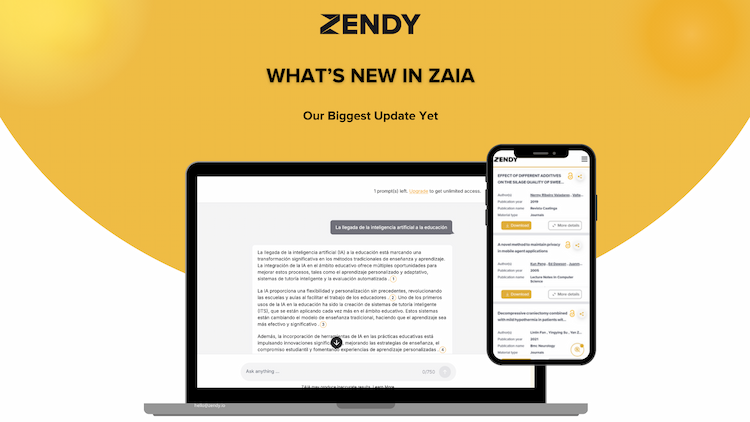
What’s New in ZAIA: Our Biggest Update Yet
We’ve rolled out one of the biggest updates to Zendy AI Assistant, ZAIA. These improvements focus on making research faster, more intuitive, and far more reliable. Here’s what’s new. Inline References You Can Trust You no longer have to scroll, copy, or cross-check to figure out where an insight came from.ZAIA now adds references directly inside its responses. If ZAIA summarises a study, explains a concept, or pulls a fact from a paper, the source appears right there in the answer, clear, traceable, and easy to verify. It feels more like reading a well-cited academic explanation than an AI output. Ask in Any Language, Get Answers in the Same Language Whether you’re researching in Arabic, Spanish, French, or Swahili, ZAIA now responds in the language you use, automatically. There’s no need to switch tools, tweak settings, or use separate translators. Just ask your question in your preferred language, and ZAIA replies in the same one.It’s a smoother experience for multilingual classrooms, international research teams, and anyone working beyond English. Search Smarter with the SOLR Agent Sometimes you know the exact paper you need, you just don’t have the title, DOI, or permalink memorised.Now you don’t have to. ZAIA’s new SOLR Agent can search using: DOI Paper title A Zendy permalink Just drop in any of these, and ZAIA fetches the correct paper instantly. It’s especially useful when you’re deep in a literature review and need to track down sources without losing your rhythm. How does it work? SOLR is the search engine behind ZAIA’s paper search.It helps ZAIA find the exact research paper you’re looking for using clear identifiers like a DOI, paper title, or Zendy link. Instead of guessing keywords or scanning long result lists, SOLR matches your input directly to the right paper, fast and accurately. ZAIA Can Now Help With Your Zendy Account You can now ask ZAIA about your subscription, billing questions, or common FAQs directly inside the platform. No switching tabs.No waiting for replies.No digging through help pages. ZAIA now serves as a support companion as well as a research assistant, especially helpful when you want quick answers in the middle of studying or writing. A Clearer, More Transparent UI One of the most noticeable upgrades is the updated interface.You’ll now see clearer “thinking” steps that show how ZAIA processes your request. It’s more transparent, easier to follow, and gives you a better sense of how ZAIA arrives at each answer, something many researchers have been asking for. Why These Updates Matter Every improvement in this update has one goal: to make research smoother and more trustworthy.Whether you're analysing papers, fact-checking a claim, working across languages, or sorting out your subscription, ZAIA is now better at supporting the full research journey. And we’re not done.This update is part of a larger shift toward a more personal and adaptive ZAIA, one that learns from how each researcher works. For now, we hope these updates make your experience on Zendy faster, clearer, and more enjoyable. If you’d like to see these features in action, just open ZAIA, Zendy AI Assistant, and try them out. .wp-block-image img { max-width: 85% !important; margin-left: auto !important; margin-right: auto !important; }
Address
John Eccles HouseRobert Robinson Avenue,
Oxford Science Park, Oxford
OX4 4GP, United Kingdom