
Wiley Collaborate with Zendy to Drive Ethical AI Through RAG-Based Innovation
 May 15, 2025 |
 7 Mins Read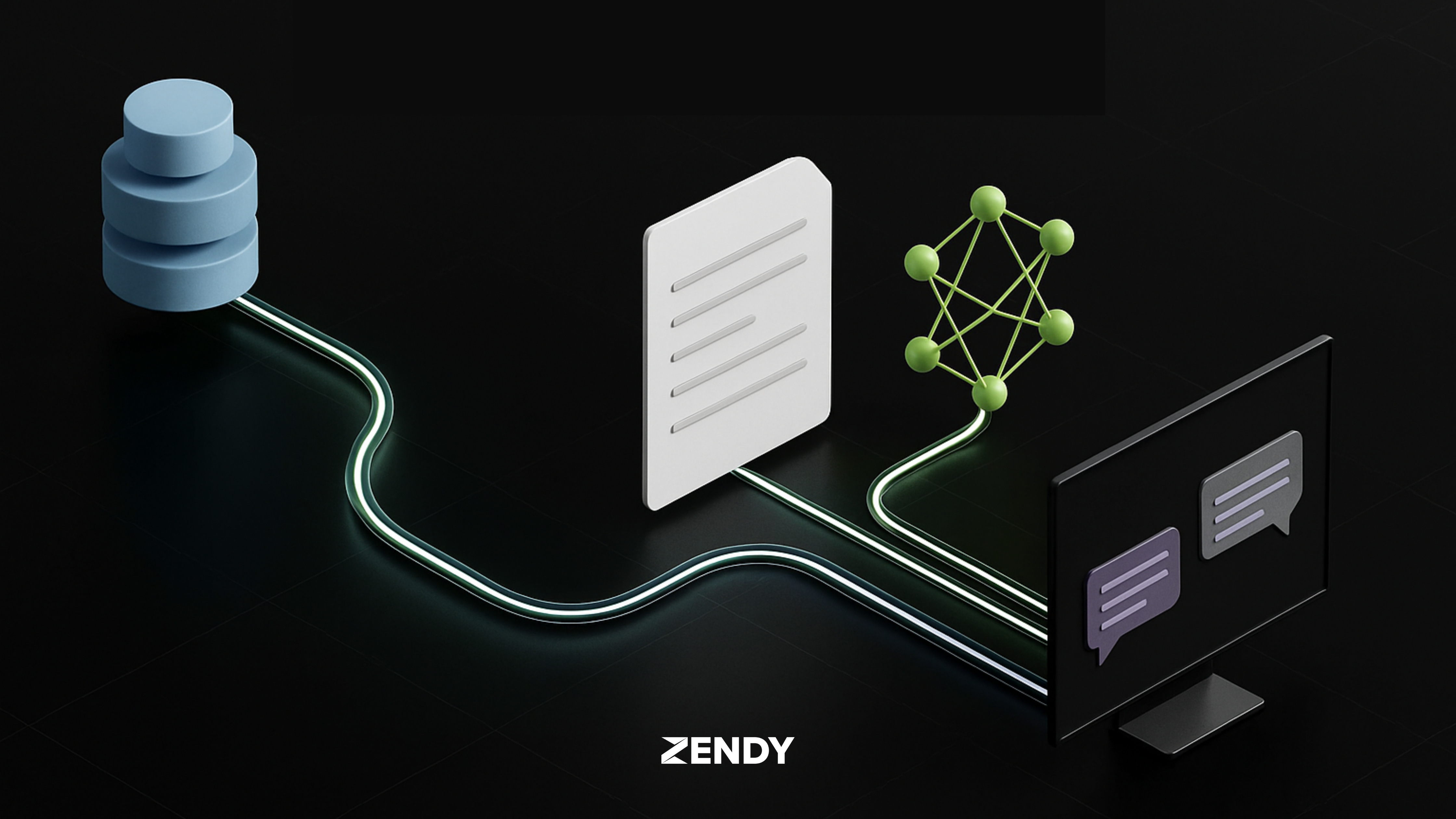
Today, we announced that Wiley has joined Zendy’s RAG-based revenue-sharing model, exemplifying a positive move toward ethical AI collaboration within the academic publishing industry.
This news builds on our March announcement of a new Retrieval-Augmented Generation (RAG)-based revenue share model, created to ensure publishers are proportionately compensated when their licensed content is cited or referenced by AI.
Publishers Indicate a Shift Toward Ethical AI Partnerships
The addition of Wiley signals growing momentum behind Zendy’s RAG-based model. They join other publishers including IT Governance, Lived Places Publishing, Lexxion, British Online Archives, Bentham Press, and e-Marefa—reflecting a shared commitment to transparency, research integrity, and publisher-supported innovation at a time when such values are critically needed.
Supported by these publishers, Zendy’s AI assistant, ZAIA, can now reference an even broader base of peer-reviewed content, ensuring that researchers receive high-quality, accurate, and fully attributed responses powered by our domain-specific large language model.
Zendy Co-founder Kamran Kardan commented:
“We’re seeing a turning point in how academic publishers view AI, we can sense an active shift from threat to partner. The inclusion of Wiley and our other partners sends a powerful message that transparent and fair licensing and ethical AI models are the way forward.”
A Transparent Model Grounded in Attribution and Licensing
ZAIA uses RAG to retrieve data from a combination of open access and licensed paywalled sources. References generated by the model are attributed, enabling Zendy to calculate compensation per citation. This ensures AI can reach its full potential without overlooking the critical questions publishers are asking. We’re building this model together with collaboration at its core.
This model is not just a technical solution, it’s a statement about the future of knowledge dissemination, where publishers are part of the AI value chain, not left behind by it.
We also see a future where attribution goes beyond paywalled content, recognising the pivotal contributions of Open Access publishers and, ultimately, individual authors. Our model is designed to be scalable across the entire scholarly communication ecosystem, ensuring that the benefits of AI reach every stakeholder in the research value chain.
Why Ethical Attribution Matters for Researchers and Institutions
For the global scholarly community, this means unrestricted access to quality, reference-backed information. With trusted sources powering responses, researchers can confidently explore new ideas.
For institutions, it creates a more defined path to AI adoption with publisher-approved, ethically referenced data, supporting academic integrity and compliance at every step.
Get Involved in the Future of AI Collaboration
We invite all stakeholders, including academic publishers, libraries, and research institutions to join us in shaping a future where AI collaboratively supports, not replaces, the foundations of scholarly communication. For more information or to book a demo of the capabilities of Zendy’s AI solutions, please visit our website.
About Zendy
We are an AI-powered research library with over 780,000 users across over 190 countries. Designed to accelerate the research process, we provide access to millions of journals, articles, and e-books, while offering a range of AI-driven tools, including ZAIA, an AI assistant that helps researchers expedite their research journey.
We collaborate with leading academic publishers to make scholarly content more accessible and affordable, ensuring that users can explore high-quality research with ease.
Zendy is a product of Knowledge E and is developed in collaboration with researchers, students, institutions, and publishers. Our mission is to democratise access to content by making it more affordable and accessible. There are no limitations on reading, just simple access to scholarly resources.
For more information, visit zendy.io.
What’s New in ZAIA: Our Biggest Update Yet
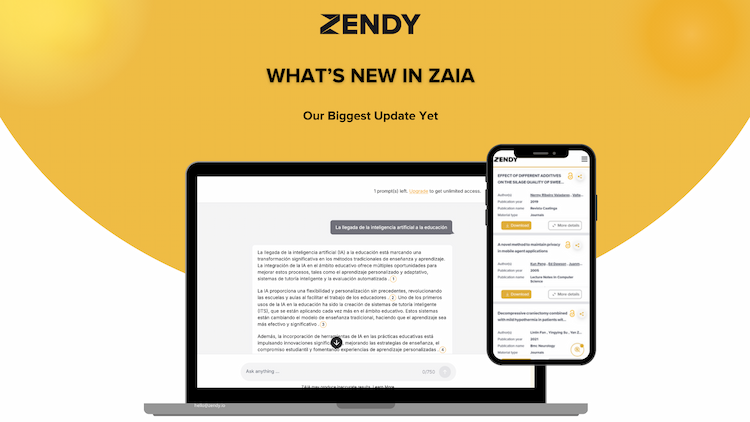
We’ve rolled out one of the biggest updates to Zendy AI Assistant, ZAIA. These improvements focus on making research faster, more intuitive, and far more reliable. Here’s what’s new. Inline References You Can Trust You no longer have to scroll, copy, or cross-check to figure out where an insight came from.ZAIA now adds references directly inside its responses. If ZAIA summarises a study, explains a concept, or pulls a fact from a paper, the source appears right there in the answer, clear, traceable, and easy to verify. It feels more like reading a well-cited academic explanation than an AI output. Ask in Any Language, Get Answers in the Same Language Whether you’re researching in Arabic, Spanish, French, or Swahili, ZAIA now responds in the language you use, automatically. There’s no need to switch tools, tweak settings, or use separate translators. Just ask your question in your preferred language, and ZAIA replies in the same one.It’s a smoother experience for multilingual classrooms, international research teams, and anyone working beyond English. Search Smarter with the SOLR Agent Sometimes you know the exact paper you need, you just don’t have the title, DOI, or permalink memorised.Now you don’t have to. ZAIA’s new SOLR Agent can search using: DOI Paper title A Zendy permalink Just drop in any of these, and ZAIA fetches the correct paper instantly. It’s especially useful when you’re deep in a literature review and need to track down sources without losing your rhythm. How does it work? SOLR is the search engine behind ZAIA’s paper search.It helps ZAIA find the exact research paper you’re looking for using clear identifiers like a DOI, paper title, or Zendy link. Instead of guessing keywords or scanning long result lists, SOLR matches your input directly to the right paper, fast and accurately. ZAIA Can Now Help With Your Zendy Account You can now ask ZAIA about your subscription, billing questions, or common FAQs directly inside the platform. No switching tabs.No waiting for replies.No digging through help pages. ZAIA now serves as a support companion as well as a research assistant, especially helpful when you want quick answers in the middle of studying or writing. A Clearer, More Transparent UI One of the most noticeable upgrades is the updated interface.You’ll now see clearer “thinking” steps that show how ZAIA processes your request. It’s more transparent, easier to follow, and gives you a better sense of how ZAIA arrives at each answer, something many researchers have been asking for. Why These Updates Matter Every improvement in this update has one goal: to make research smoother and more trustworthy.Whether you're analysing papers, fact-checking a claim, working across languages, or sorting out your subscription, ZAIA is now better at supporting the full research journey. And we’re not done.This update is part of a larger shift toward a more personal and adaptive ZAIA, one that learns from how each researcher works. For now, we hope these updates make your experience on Zendy faster, clearer, and more enjoyable. If you’d like to see these features in action, just open ZAIA, Zendy AI Assistant, and try them out. .wp-block-image img { max-width: 85% !important; margin-left: auto !important; margin-right: auto !important; }

Zendy and Casalini Libri Partner to Expand Access to European Humanities and AI Research Tools
Oxford, UK – Dec, 2025 – Zendy, the AI-powered research library, and Casalini Libri, one of the leading providers of European scholarly content and library services, have signed a partnership agreement to expand access to high-quality academic research in the humanities and social sciences. This strategic collaboration will make Casalini Libri’s extensive collection of European scholarly publications, including academic journals, monographs, and specialist research outputs, available on Zendy’s platform. The content will be discoverable through ZAIA, Zendy’s AI research assistant, helping librarians, researchers, students, and academic institutions worldwide find and engage with relevant European scholarship more efficiently. With over 800,000 users across 191 countries and territories, Zendy continues to grow as a trusted destination for discovering academic knowledge. By integrating Casalini Libri’s content, Zendy strengthens its mission to improve access to regionally significant scholarship and ensure that important European research is more visible, searchable, and widely used. Casalini Libri is internationally recognised for its deep expertise in European humanities and social sciences, with a particular focus on Southern Europe and broader continental scholarship. Through this partnership, these resources will reach a wider global audience, helping address long-standing discoverability challenges faced by non-English academic content. The collaboration also reflects Zendy’s commitment to linguistic and regional diversity in research. In a scholarly ecosystem where English-language publications dominate, increasing access to European research traditions is essential for a more balanced and representative academic landscape. Zendy users will now be able to explore Casalini Libri’s content seamlessly on the platform, supporting teaching, research, and interdisciplinary work rooted in European intellectual traditions. Together, Zendy and Casalini Libri aim to increase the global reach and impact of European scholarship. For more information, please contact:Lisette van KesselHead of MarketingEmail: l.vankessel@knowledgee.com About Zendy Zendy is an AI-powered, mission-driven, trustworthy research library dedicated to increasing the accessibility and discoverability of scholarly literature, particularly in the global south and underserved regions. The platform currently serves over 800,000 users across 200+ countries and territories, offering a comprehensive collection of academic journals, books, and reports to empower researchers, educators, and students. Zendy also provides AI tools, including its research assistant ZAIA, to help users read, analyse, and summarise academic content more efficiently. Website: https://zendy.io About Casalini Libri Casalini Libri is a leading supplier of European scholarly publications and library services, specialising in humanities and social sciences research. For decades, Casalini Libri has worked closely with publishers, libraries, and research institutions to curate, distribute, and preserve high-quality academic content, supporting the global exchange of European scholarship. .wp-block-image img { max-width: 85% !important; margin-left: auto !important; margin-right: auto !important; }

Zendy and WT Cox Partner to Expand Access to Scholarly Content for US Libraries
Oxford, UK – Dec, 2025 – Zendy, the AI-powered research library, and WT Cox, a leading US provider of library content, subscription management, and collection services, have signed a partnership agreement to expand access to scholarly research for academic and institutional libraries across the United States. This strategic collaboration will enable libraries working with WT Cox to benefit from Zendy’s extensive digital research collection and AI-powered discovery tools, supporting researchers, students, and faculty with broader, more affordable access to academic literature. With more than 800,000 users across 200+ countries and territories, Zendy continues to grow as a trusted platform for discovering and working with scholarly content. Through this partnership, WT Cox will support US libraries in offering Zendy as part of their digital collections, helping institutions address rising content costs while expanding access to high-quality research. WT Cox has a long-standing reputation for supporting libraries with flexible subscription models, personalised service, and deep expertise in academic collection development. By partnering with Zendy, WT Cox strengthens its ability to meet evolving library needs in an increasingly digital and research-driven environment. The collaboration reflects a shared commitment to supporting libraries as critical gateways to knowledge. As libraries face increasing pressure to provide wider access to research with limited budgets, solutions that combine scale, affordability, and intelligent discovery are becoming essential. Zendy users accessing content through participating libraries will benefit from advanced search, AI-assisted research tools, and a growing collection of scholarly publications across disciplines. Together, Zendy and WT Cox aim to support US libraries in delivering more accessible, discoverable, and sustainable research services to their communities. For more information, please contact:Lisette van KesselHead of MarketingEmail: l.vankessel@knowledgee.com About Zendy Zendy is an AI-powered research library dedicated to improving the accessibility and discoverability of scholarly literature, particularly in the global south and underserved regions. The platform serves more than 800,000 users across 200+ countries and territories, offering access to millions of academic journals, articles, and research outputs supported by AI-driven research tools. About WT Cox WT Cox is a leading US-based provider of library subscription services, collection management, and digital content solutions. Serving academic, special, and research libraries, WT Cox supports institutions with tailored services designed to simplify access to scholarly resources and support evolving research needs. .wp-block-image img { max-width: 85% !important; margin-left: auto !important; margin-right: auto !important; }
Address
John Eccles HouseRobert Robinson Avenue,
Oxford Science Park, Oxford
OX4 4GP, United Kingdom